Braids don’t quit. They also don’t sit still, new partings, new textures, new ways to wrap the crown keep the look alive across seasons. A good braid style holds for weeks, moves with you from desk to dinner, and photographs like you meant it every time, which is why Pretty Braids for Black Women 2027 fill so many saved boards.
The 29 ideas here run the full range: tight scalp work, loose coily falls, highlights woven through dark bases, beads clicking at the ends. Some ask for a full afternoon in the chair; others refresh a familiar shape. What each one shares is a parting pattern or a finish that makes the extra hour worth it.
Cornrows transitioning into loose braids with thick, coily texture
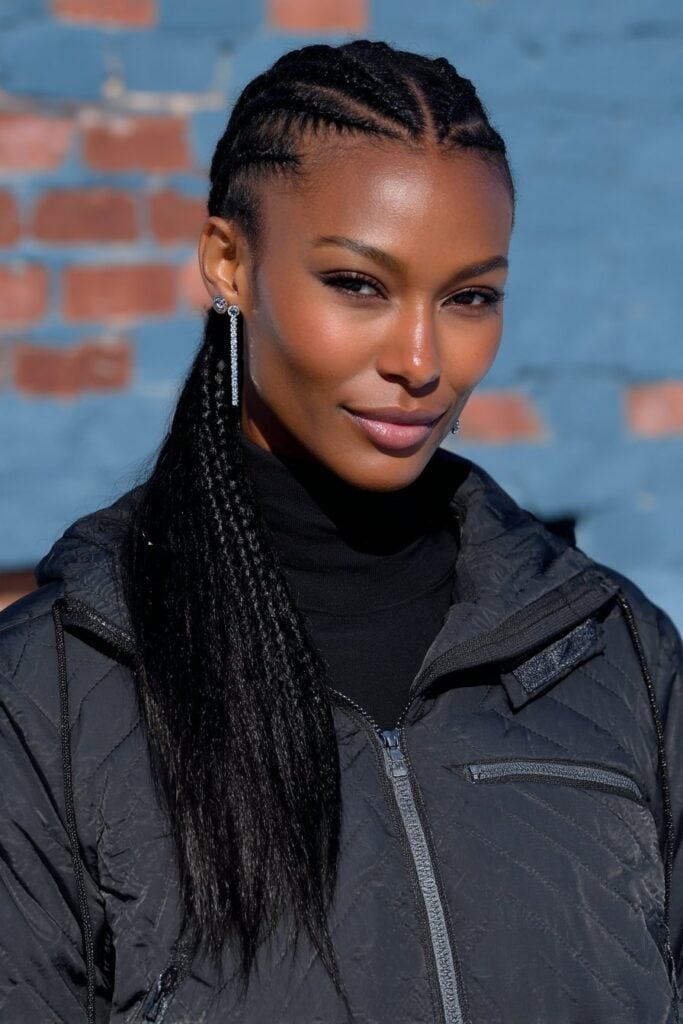
Neat cornrows run tight along the scalp, then release into loose braids that fall with their own weight. The thick, coily texture keeps each braid full without extra bulk. A middle part splits the design cleanly, so the transition looks deliberate. Thick, coily hair types get the best grip here. The braids hold their shape and the loose section moves like it belongs. Ask your stylist for cornrows transitioning to loose braids. Plan a scalp cleanse every few days; the tight rows stay fresh that way.
Intricate cornrows with a geometric pattern leading into coily braids
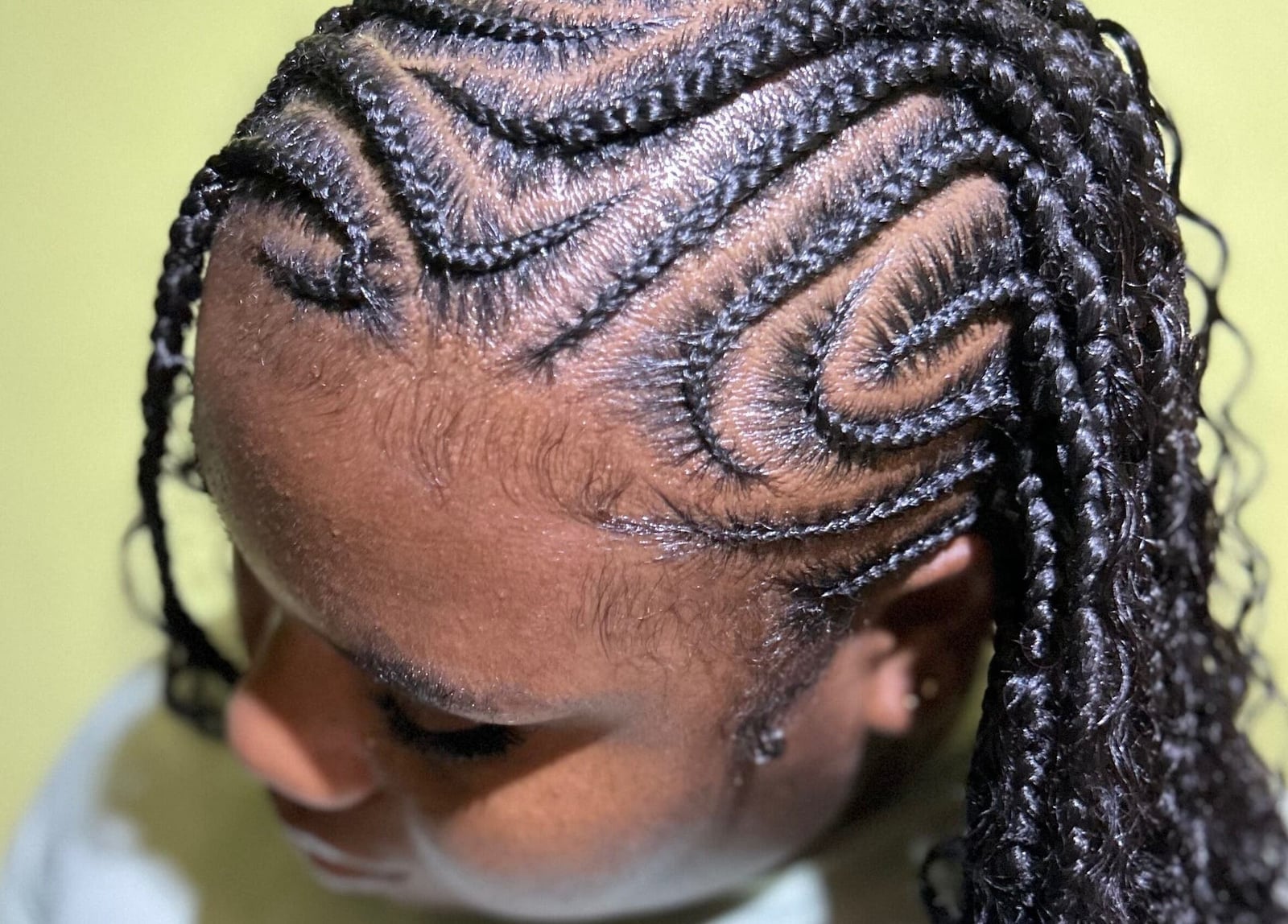
The geometry sets this apart from standard straight-back cornrows. Parting cuts sharp angles across the scalp before the braids release into coily texture. A side profile view makes the pattern the whole point. Thick, coily hair holds those lines cleanly for weeks. This is not a quick styling routine. The parting alone takes time. A dry shampoo or witch hazel spritz keeps the scalp fresh between washes.
Swirled cornrows on the crown with long, coily braids
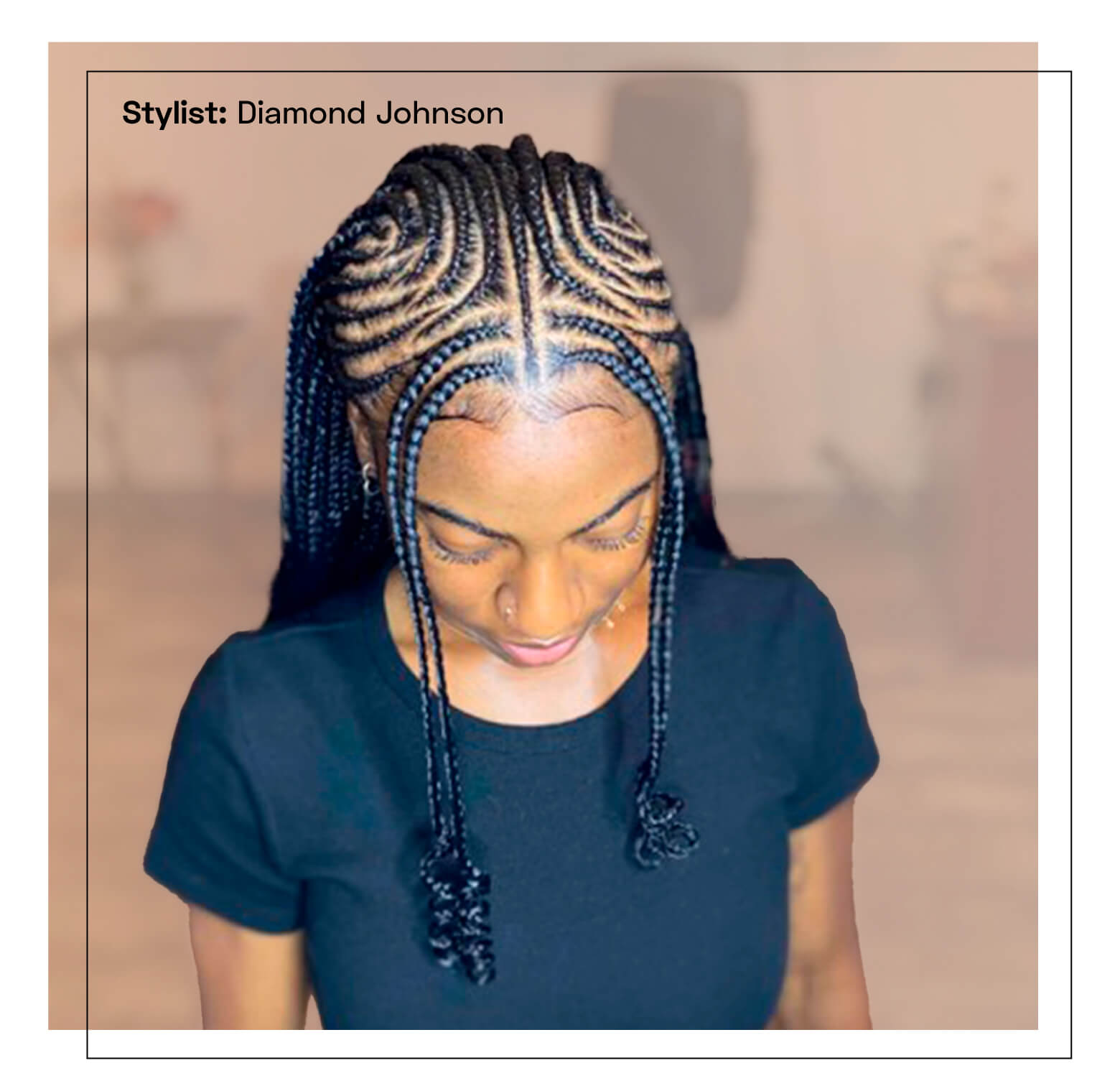
Does the crown need a focal point? Swirled cornrows spiral into the center, then drop into long, thick, coily braids. Two face-framing pieces curl at the ends, softening the whole shape. The deep black color reads solid, no highlights needed.
Thick, coily hair carries this pattern best. The swirls stay defined and the braids keep their weight. Skip it if you prefer minimal styling around the hairline; those face-framing pieces need resetting every few weeks. Tell your stylist: swirled cornrows with long coily braids. A light oil on the scalp every other day prevents dryness at the roots.
Blonde highlights on zig-zag parted cornrows
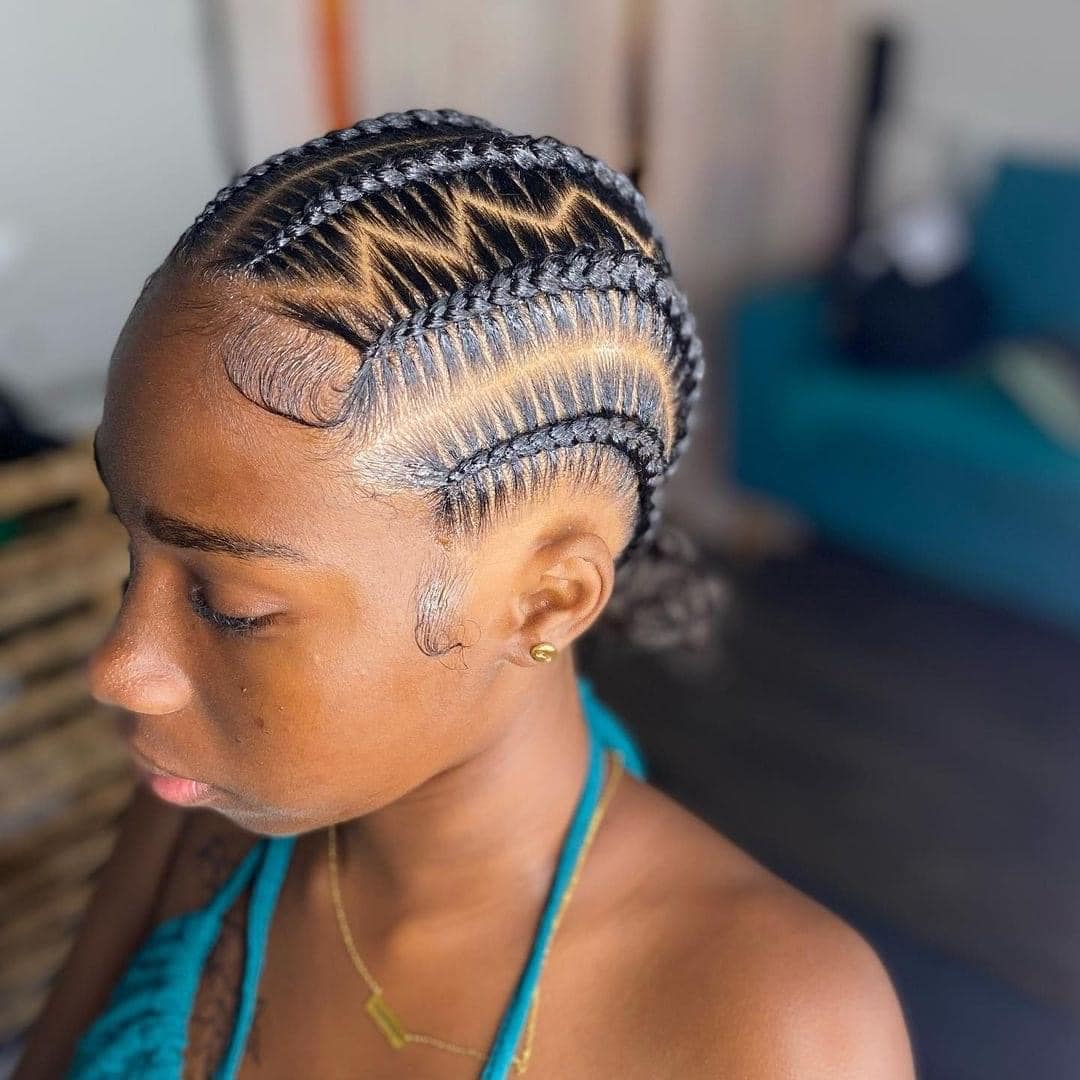
Zig-zag partings break the scalp into alternating triangles, and the blonde highlights catch each section differently. Black hair stays the base; the blonde weaves through as thin streaks, not a full color. The laid edges seal the finish. Thick, coily hair holds both the tight rows and the color well. Solid color braids are another option. The blonde needs upkeep to stay bright. A color-safe shampoo extends the life of the highlights.
Neatly parted cornrows with a diagonal pattern
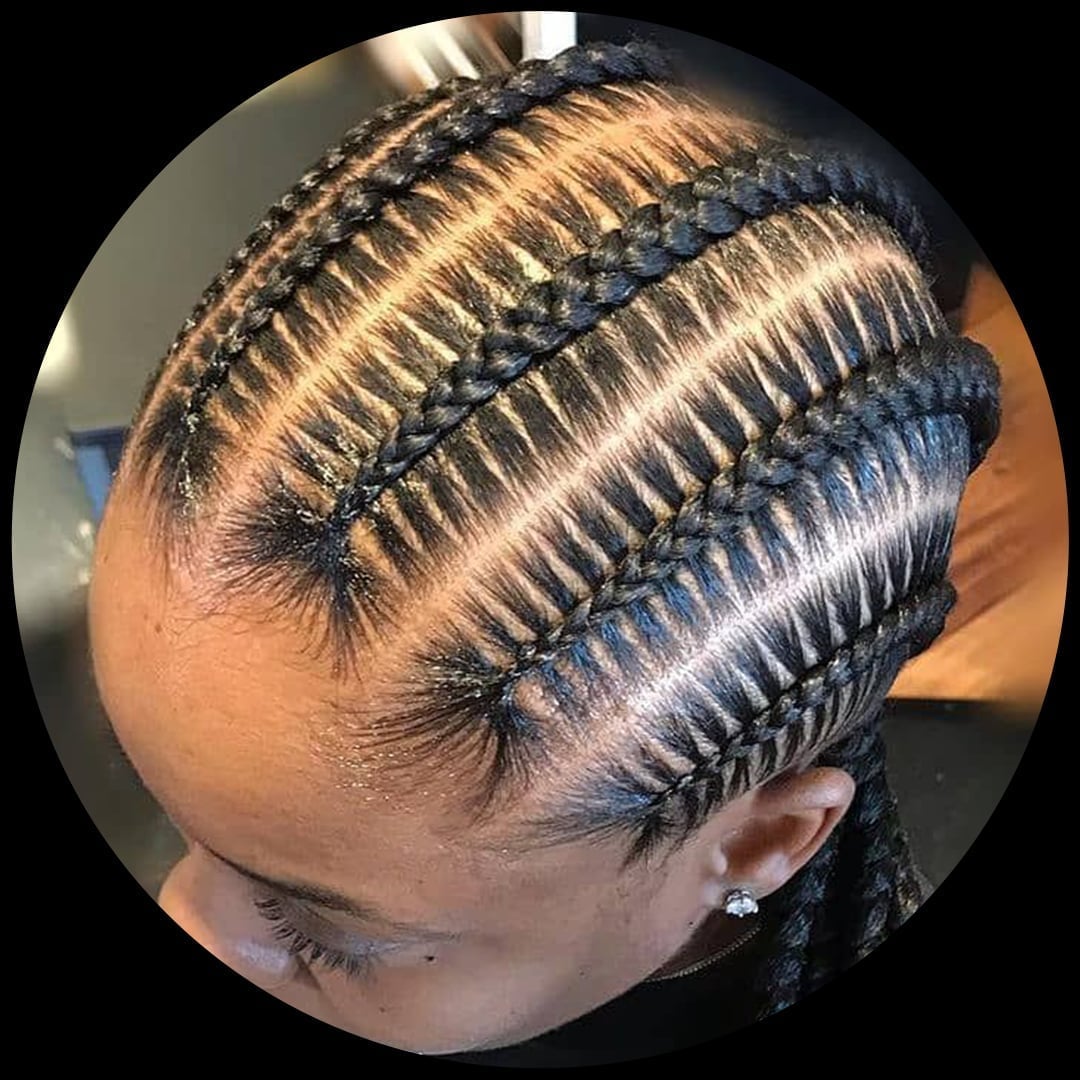
Diagonal partings run from the crown forward, each row thick and tightly woven against the scalp. The black hair reads dark and uniform, no highlights, no variation, just precision. A side view shows the clean lines best. Thick, coily hair keeps those rows crisp for the full wear. The diagonal line is the whole pattern. Ask your stylist for cornrows with diagonal parting. Gentle scalp cleansing every few days keeps buildup away from the tight rows.
Straight-parted cornrows extending into long, thick braids
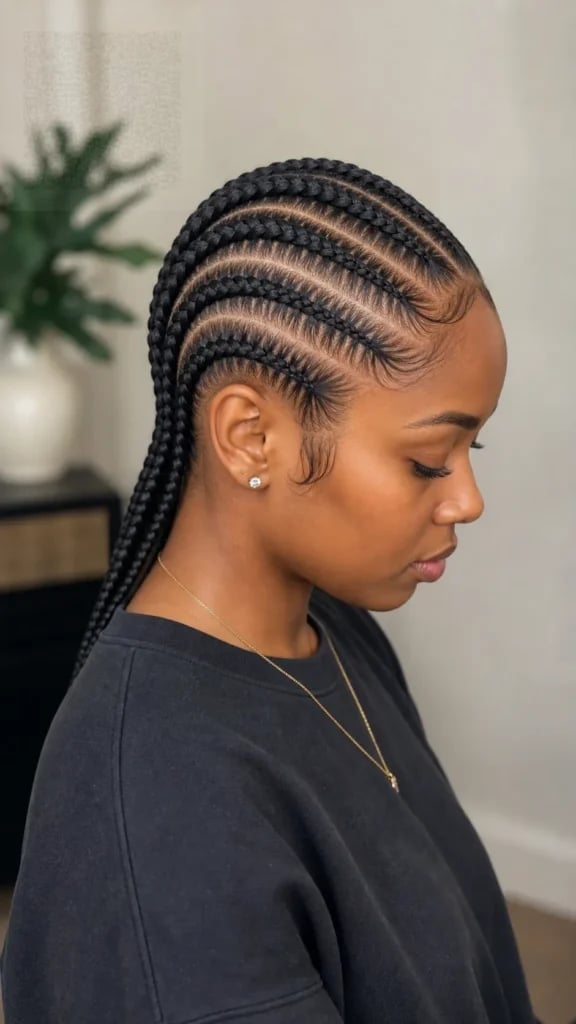
Set this against the kind of cornrow-to-braid look where the cornrows narrow into thin braids. Here the transition is a straight trade: each cornrow expands immediately into a thick braid of the same width. The side profile shows every part running parallel from the middle part to the nape, no curves, no diagonal shifts. Thick, coily texture holds the shape without frizz between the sections.
The length lands past the shoulders, so the weight pulls the braids straight. A trim every eight weeks keeps the ends even. Black hair color means no root touch-up schedule, just a light serum on the braids every few days. This style sits flat against the scalp from the part to the crown.
Neat, side-parted cornrows transitioning into box braids
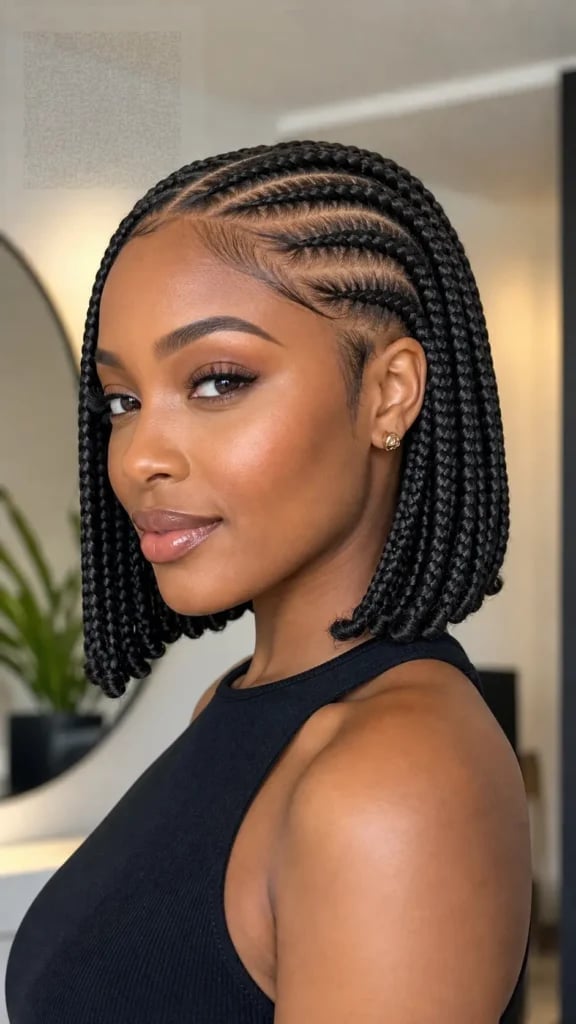
A sharp side part divides the cornrows into two distinct fields: tighter rows on the larger side, a few short rows on the smaller side. The cornrows feed directly into box braids of the same thickness, so there is no bump where the technique changes. Side-swept bangs break the line of the part. Coily texture keeps each braid defined. Ask your stylist for: side-parted cornrows into box braids. The part needs a precise razor or a fine-tooth comb, not a job for a rushed chair.
High ponytail with curved cornrows and long black braids
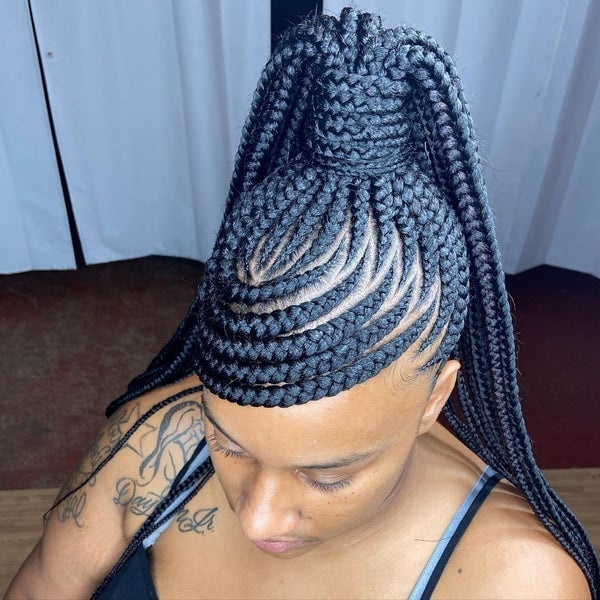
Curved cornrows sweep from the hairline toward the crown, each row following the same arc like a contour line on a map. Where they meet at the top, the hair gathers into a high ponytail of long black braids. The scalp shows between the rows, which means the pattern reads clearly even from a few feet away. Thick, coily texture gives the ponytail weight that holds its shape through a workout or a windy commute.
This one suits anyone who wants a ponytail that stays put without a dozen pins. The catch: a high ponytail pulls at the hairline, so give the edges a break between installs. Occasion runs from Saturday errands to a casual dinner. The curved rows mean the style already has movement built in. No need to adjust it once it leaves the chair.
Baby hairs frame swirled cornrows into box braids
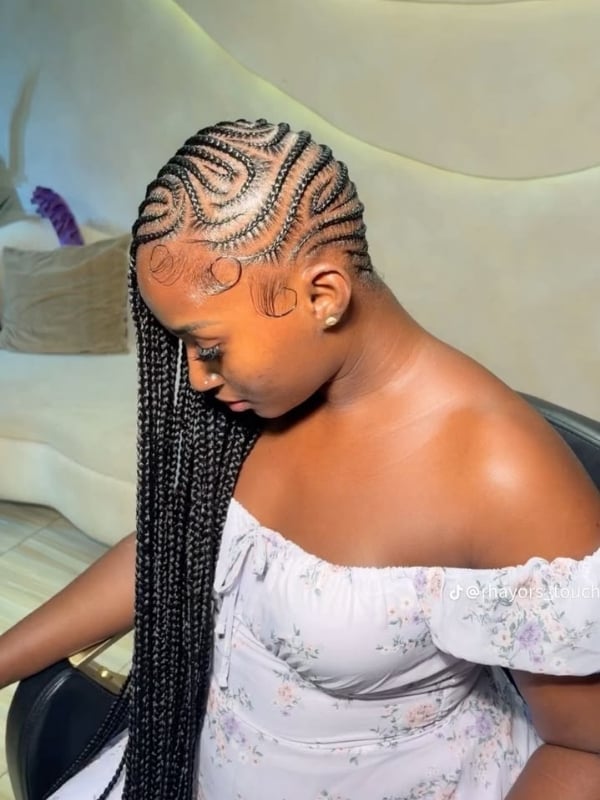
Swirled cornrows start at the temple and curve inward like a fingerprint, each row a clean arc that meets the next at the crown. Below the swirls, long box braids fall past the shoulders in a deep black shade. The detail that sets this apart: baby hairs laid in delicate curls along the hairline, each one shaped with a soft brush and a holding product. Ask your stylist for: swirled cornrows with long box braids and baby hairs. The swirls require a steady hand, so book a stylist who does geometric patterns regularly.
Half-updo with geometric parting and curly braids
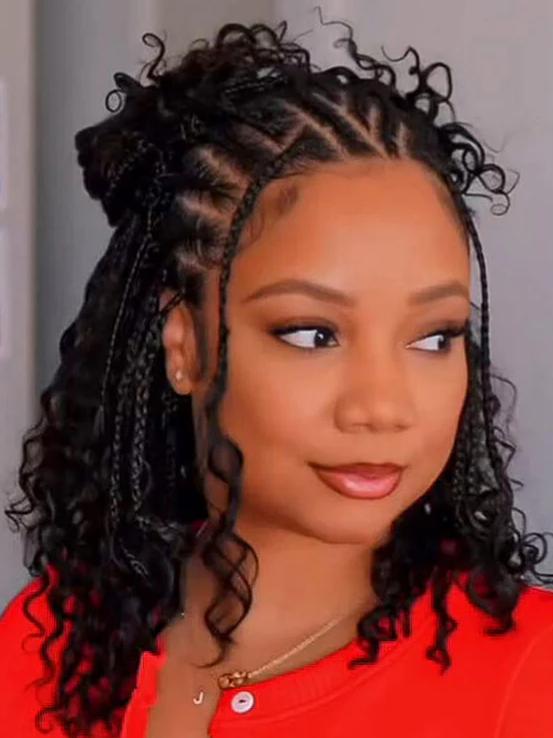
Does the half-updo ever look like you just forgot to finish the top? This one does not. A geometric parting on the crown creates a clean rectangle of braids that are pulled back and secured, while the lower section falls in loose, curly braids. A few loose tendrils break the line at the temples. Thick, coily texture gives the curly ends enough body to hold their shape without product. The geometric part stays sharp for about a week before the edges soften. Refresh the curly ends with a water mist every couple of days.
Braids and loose waves with subtle brown highlights
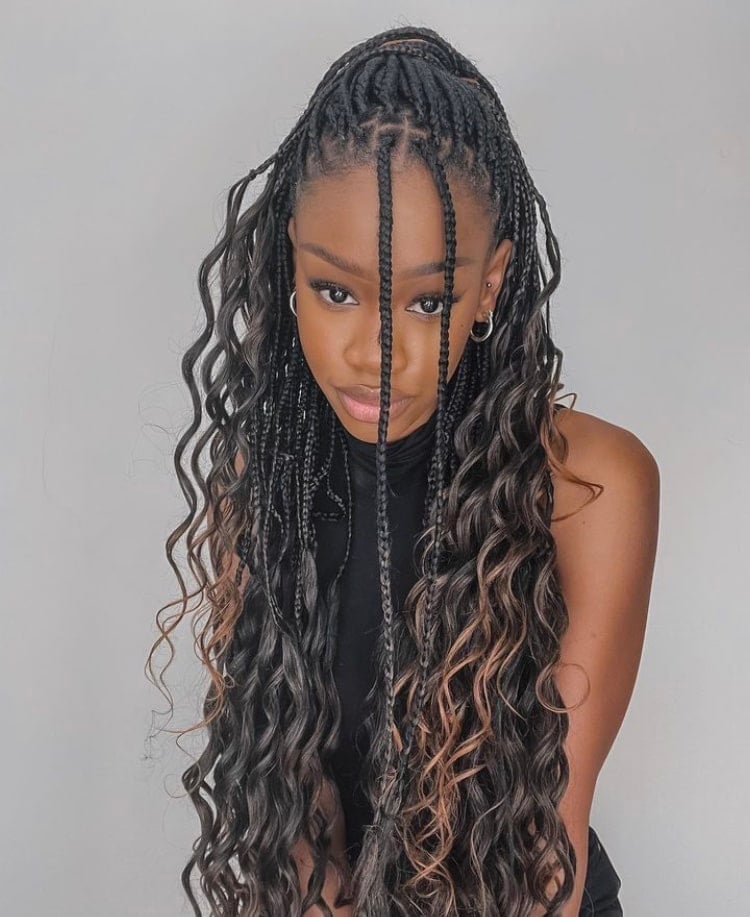
Compare this to a style where every strand is braided. That one looks uniform. This one looks deliberate contrast. Black hair with subtle brown highlights is sectioned into two textures: intricate braids near the scalp and loose waves through the length. The middle parting keeps the split balanced. Thick, coily and wavy hair holds this combination best because both textures need density to look intentional rather than unfinished. The catch: you maintain two separate textures, which means more time in the chair.
Tell your stylist: braids and loose waves with subtle brown highlights. Alternate between refreshing the braids with a light oil and moisturizing the wavy sections. Salon upkeep is required, but the blended look justifies the commitment.
Dark brown box braids with auburn highlights and wavy ends
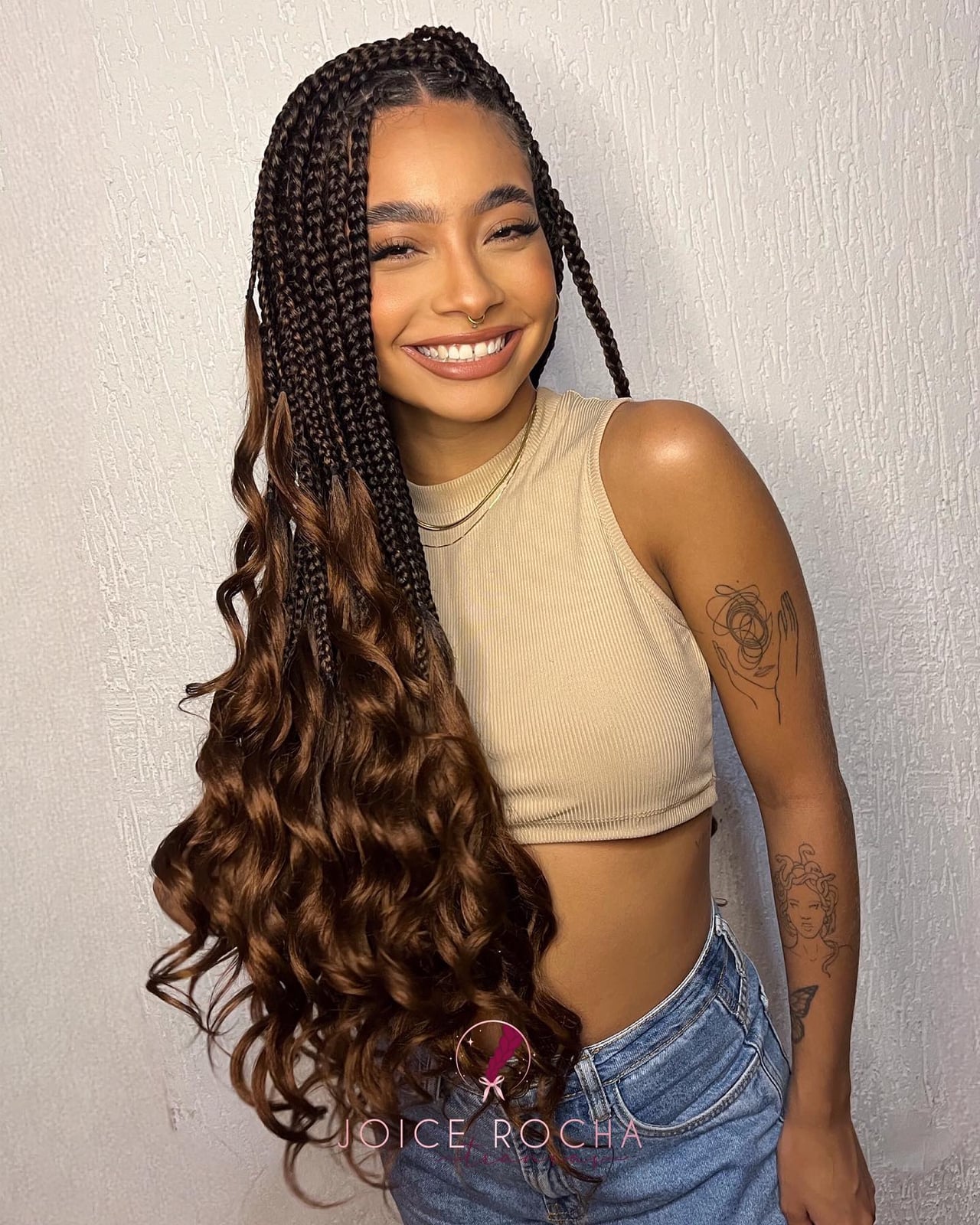
A dark brown base keeps the style grounded. Subtle auburn highlights run through the braids. The ends are left loose in voluminous, coily waves, which softens what box braids can sometimes feel like: a single texture wall. The middle parting shows off the color blend evenly on both sides. Thick, coily hair supports the braids and the wavy ends well.
Book it as: dark brown box braids with auburn highlights and wavy ends. It works best for those who want dimension in their braids. The auburn pieces need toning to keep the warmth from turning brassy, so budget for a gloss every eight weeks.
Honey blonde box braids with dark roots and curly ends
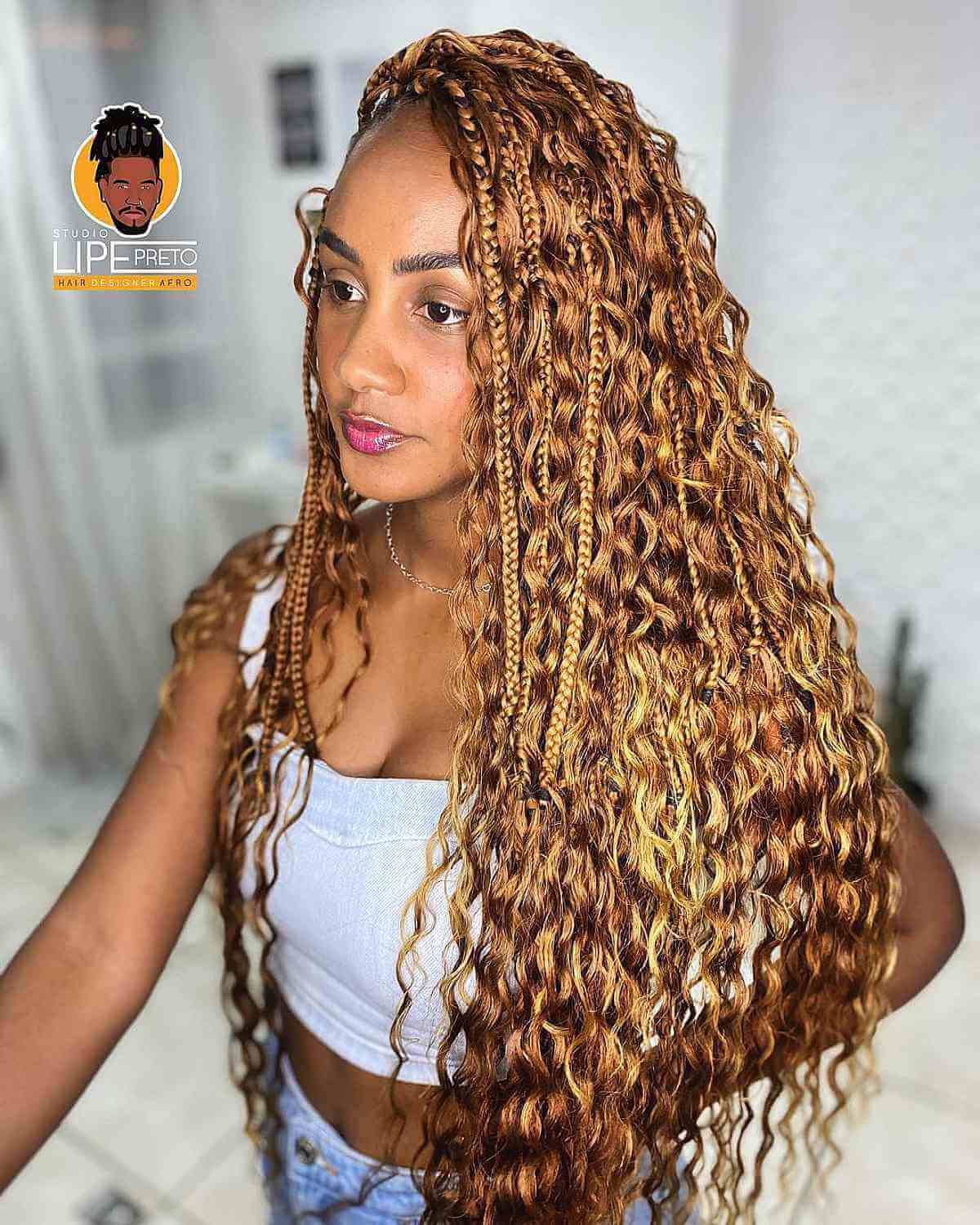
Honey blonde meets dark brown roots. The contrast is intentional, not a grow-out. The braids run clean to the middle part, then release into loose, defined curls at the ends. That shift from tightly braided to free-flowing is what makes the style work. Thick, coily hair gives the curls enough body to hold their shape.
Ask your colorist for: honey blonde box braids with dark roots and curly ends. Pass when you prefer natural brown or black. The blonde demands a purple shampoo every few washes to keep the tone from pulling yellow, but the dark root means no rush to touch up.
Long blonde box braids with colorful beads
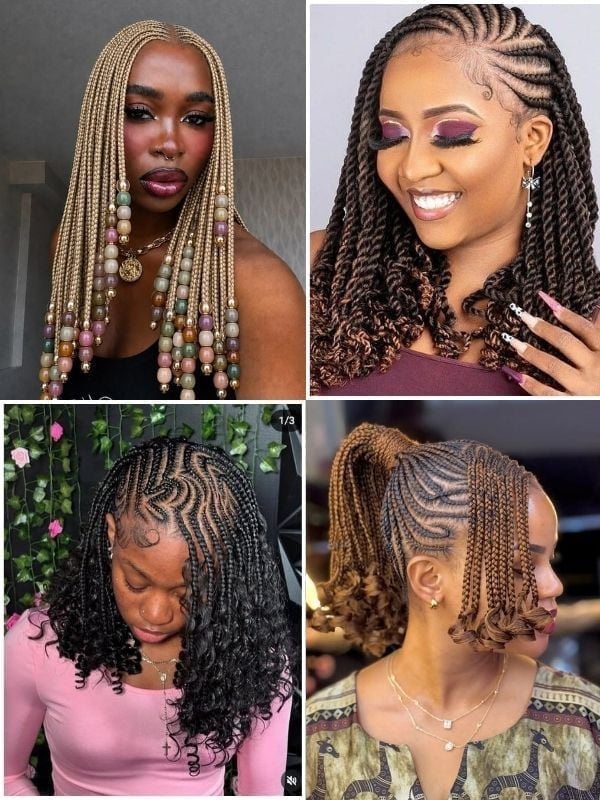
Blonde box braids run long past the shoulders. Colorful beads in varying sizes are threaded onto the ends, adding weight and movement. The middle part keeps the layout symmetrical. Some ends are left coily below the beads, which softens the overall line. Thick, coily hair supports the extra weight of the beads without pulling at the scalp.
The stylist braids the hair, then slides each bead onto the end and seals it. The beads clink when you move. This look is not for a quiet, minimalist aesthetic. The beads also mean you cannot sleep without a satin scarf, or you wake up to a tangled mess.
Fine blonde box braids with curled ends and darker roots
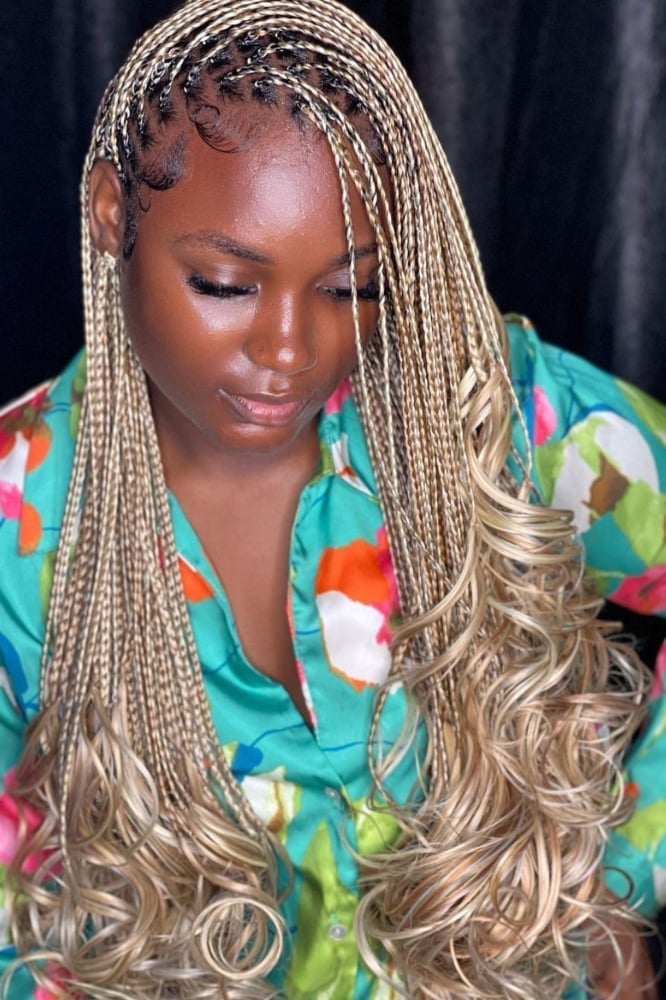
Blonde box braids done fine, not thick. The side parting breaks the symmetry and lets the braids fall in a single direction. Curled ends add bounce to what could look flat. The darker roots create depth against the lighter length, so the color does not wash out the scalp area. Fine, coily hair benefits from the smaller section size, which distributes tension evenly and creates more perceived volume.
Tell your stylist: fine blonde box braids with curled ends. A light mousse defines the curls without weighing them down. The upkeep rhythm: a trim on the ends every ten weeks to keep the curls uniform. Not for anyone with very thick hair who wants chunky braids; the fine sections will feel too small.
Laid baby hairs with long black box braids
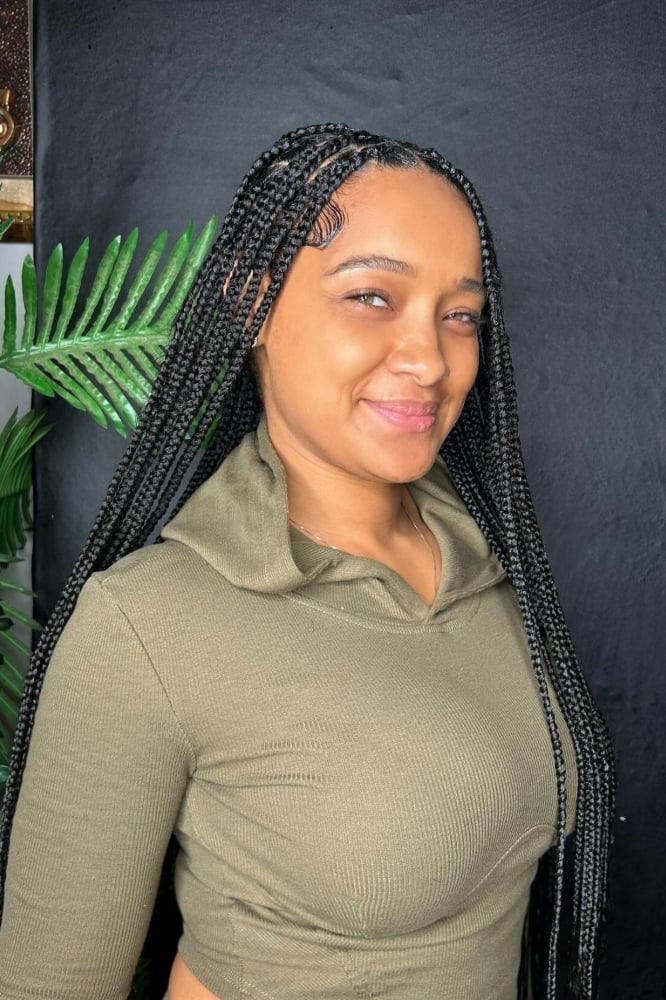
Long black box braids with a middle parting already look neat. Add laid baby hairs and the finish moves from neat to deliberate. You need thick, coily hair for a sleek edge. The catch: those baby hairs need daily attention with edge control, and the braids need salon maintenance every six to eight weeks. A middle parting keeps the look balanced. Skip if you prefer a natural hairline.
Clean middle part on long neat box braids
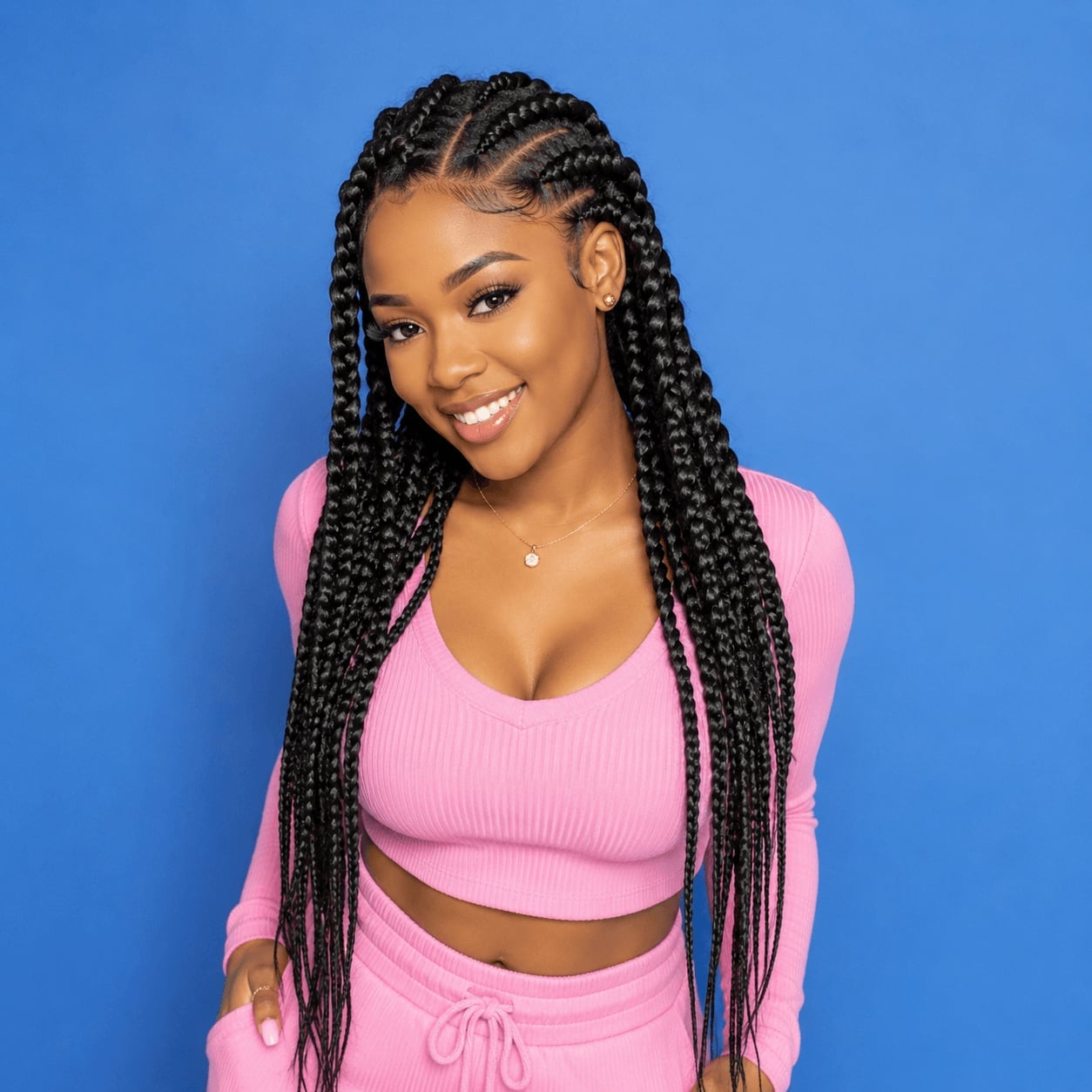
Ask your stylist for: long neat box braids with middle parting. The parting is the backbone of this style. If the line wavers, the whole look softens. A square or round face suits a middle part well; it balances without adding width at the sides.
Long, neat box braids falling down the back
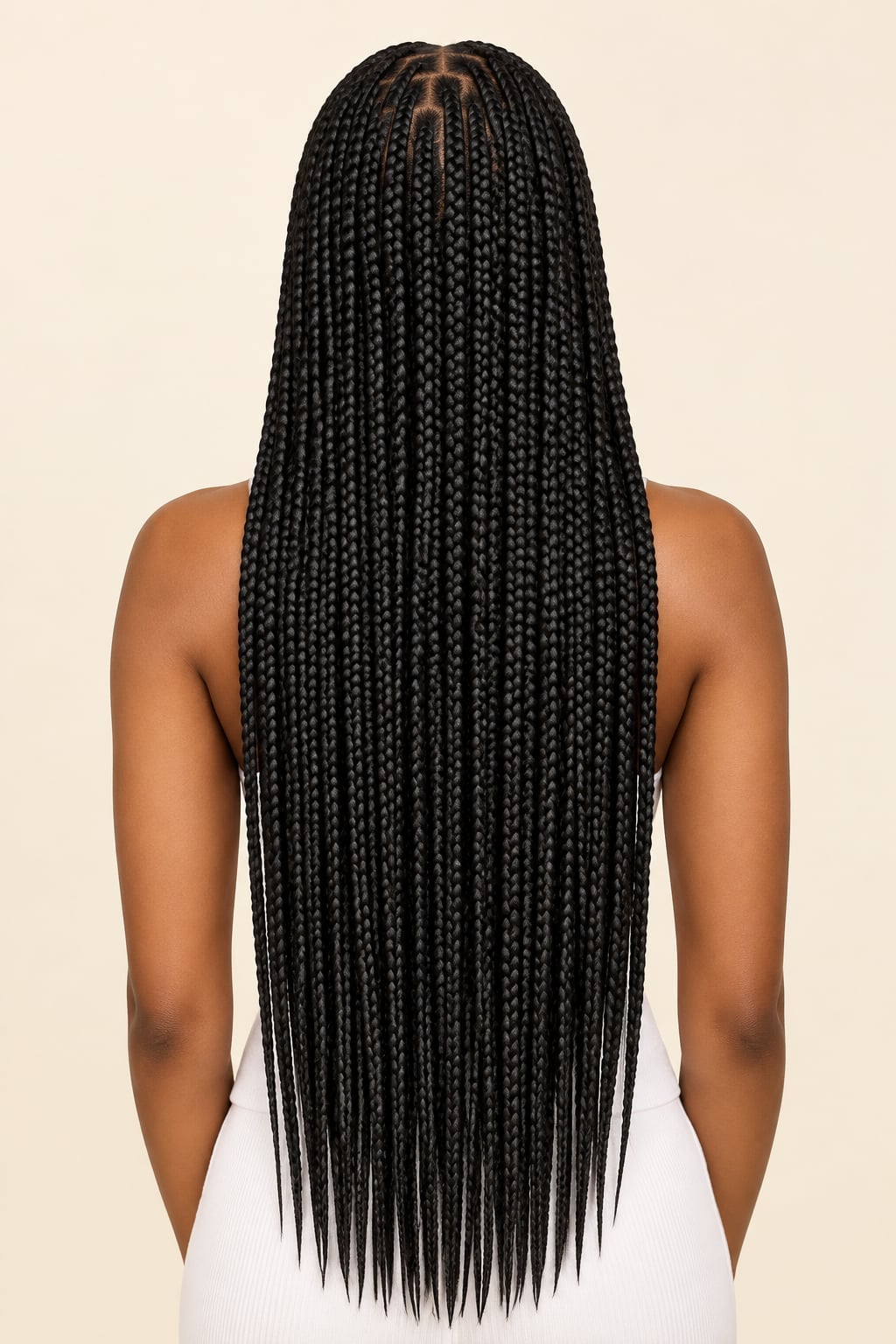
From the back, the design becomes clear. Long, neat box braids fall straight down from a middle parting, the black color uniform from root to tip. The braids are thick enough to hold their shape without looking heavy. This style genuinely flatters anyone with thick, coily hair who wants length without bulk at the crown.
Pass when you prefer shorter braids or a different parting. The middle parting is non-negotiable here; it centers the weight and keeps the fall even. Professional installation is required for the precision this look demands. A round face gets elongation from the vertical lines, while a long face benefits from the width the braids add at the sides.
Thick, chunky braids styled down the back
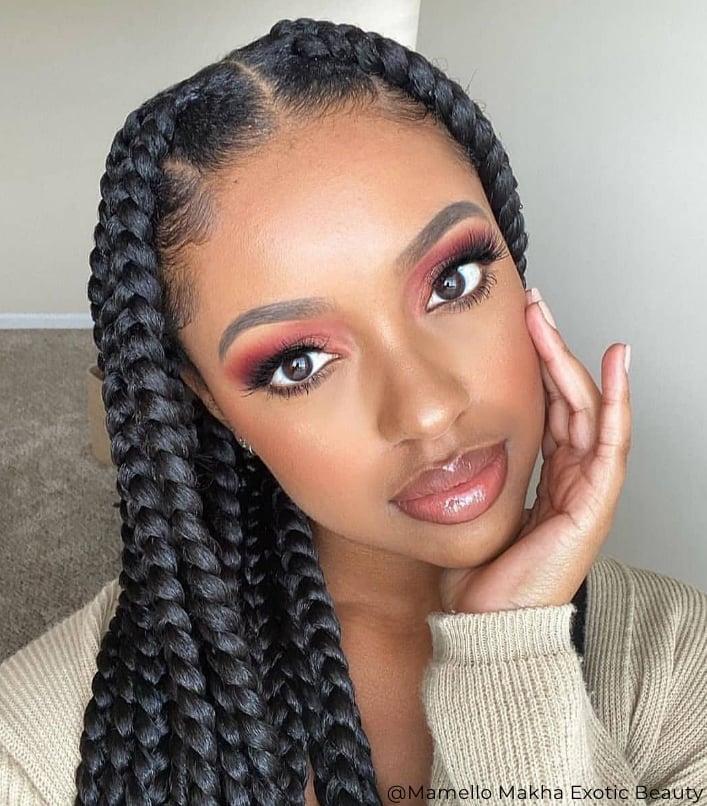
Start with the part. A middle parting, clean and straight, sets the foundation. Ask your stylist for: thick chunky braids. The words matter because chunky means fewer braids, each one substantial. Black color keeps the texture readable. Thick, coily hair holds this shape best; finer hair may not fill each braid evenly.
Book it as: thick chunky braids, middle parting. The braids fall down the back, each one thick enough to see the twist pattern. Fewer braids means less tension on the scalp, which some prefer. The look looks bold and deliberate.
Box braids with geometric parting on the crown
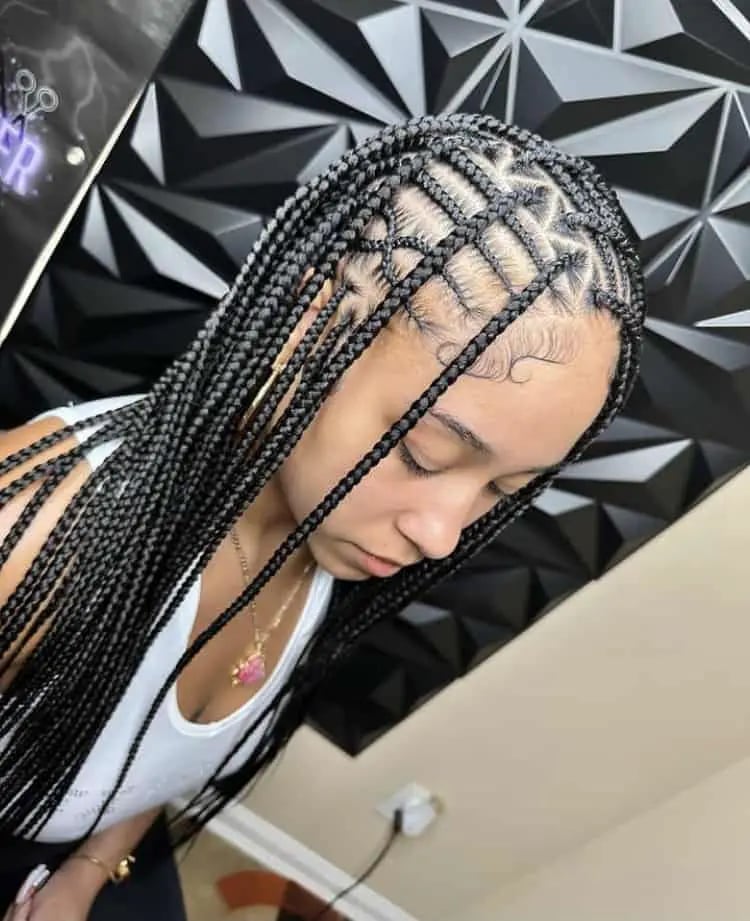
Long box braids in deep black are divided by precise geometric partings at the crown, creating a pattern that draws the eye upward. This suits thick, coily hair that can hold sharp parting lines.
Not for those who prefer a simple part. The geometric pattern requires salon skill to keep the lines straight and the angles consistent. The braids fall as usual, so the upkeep is standard: maintenance every six to eight weeks. The design holds its shape well between appointments.
Zig-zag partings on thick black braids
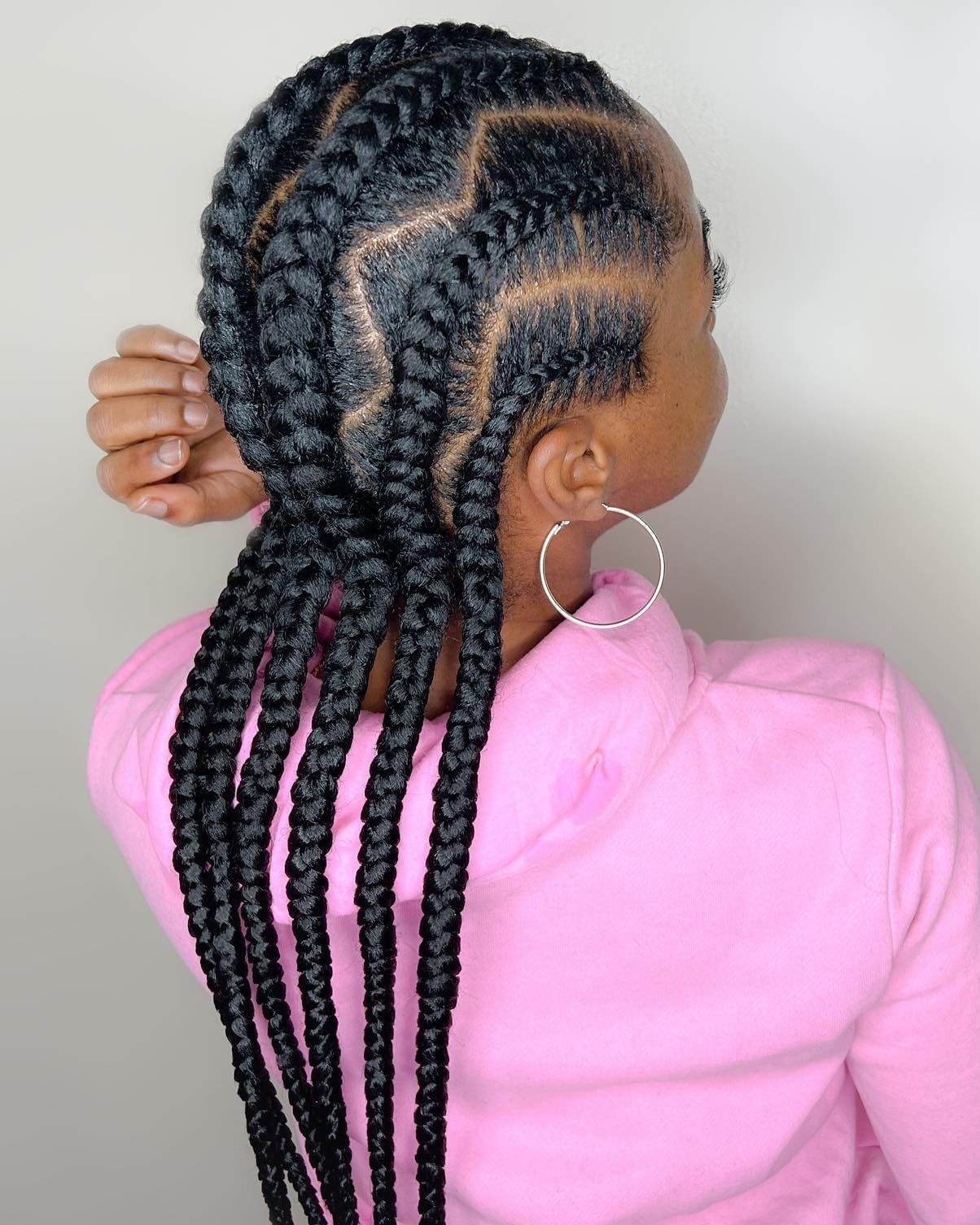
Compare two braided sets side by side. One has straight partings; the other has this zig-zag geometry across the scalp. The difference is all in the line work. Thick, coily hair takes the pattern best. The partings stay crisp and the braids hold their uniform shape. Keep the scalp clean to make the zig-zag visible; product buildup blurs the effect fast. Pass when you prefer a softer, less defined part.
Cornrows in a swirling pattern with honey blonde highlights
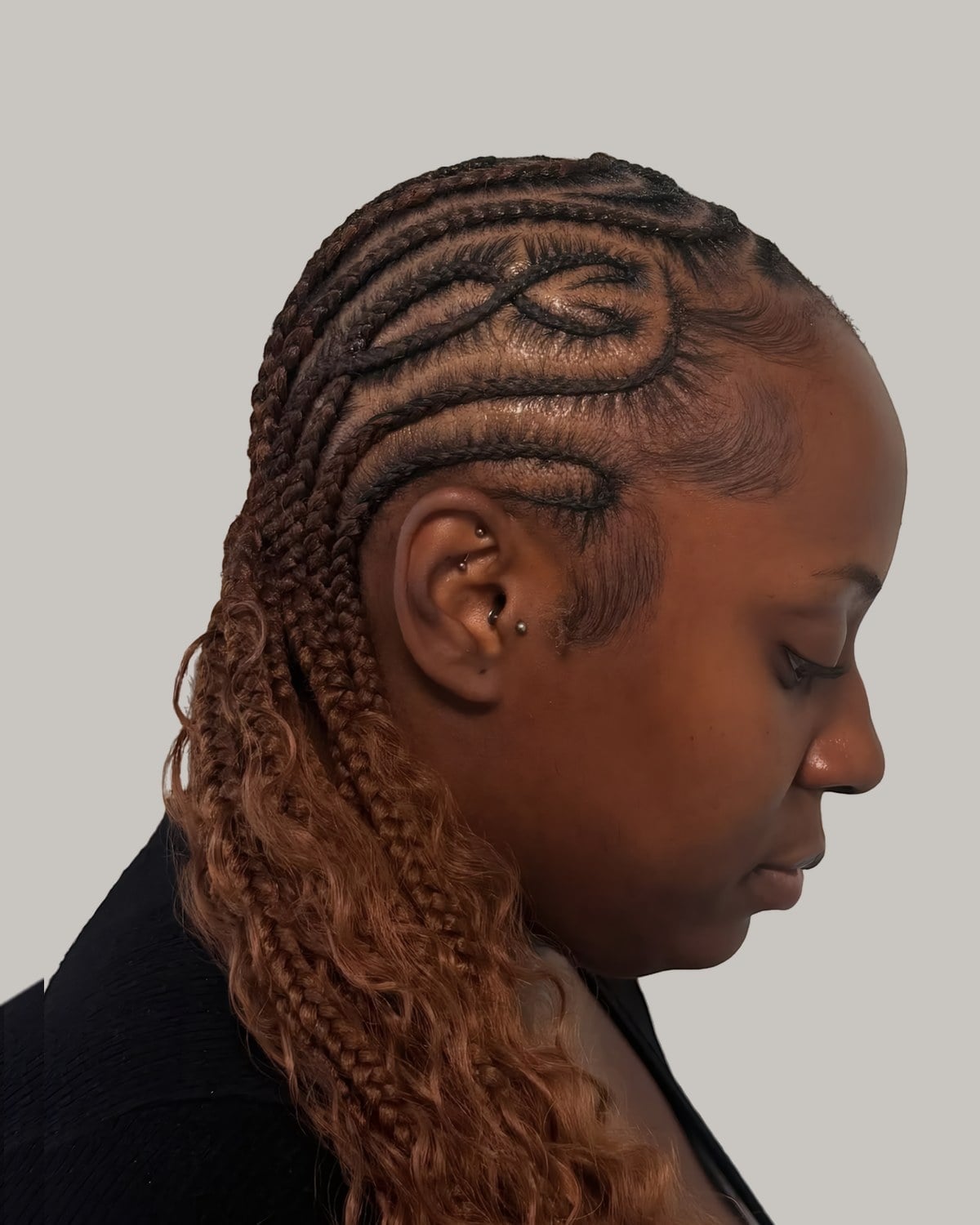
Set this against a straight-back cornrow set. Where that one moves in rows, this one curves into a swirl at the side before the braids drop loose and wavy. The dark brown base grounds the honey blonde highlights, so the lighter pieces look deliberate, not accidental. Thick, coily hair holds the swirl pattern without the parts pulling apart. Tell your colorist: cornrows with swirling pattern and honey blonde highlights. The wavy ends need a moisturizer every few days to keep from drying out.
Geometric scalp braids transitioning into thick box braids
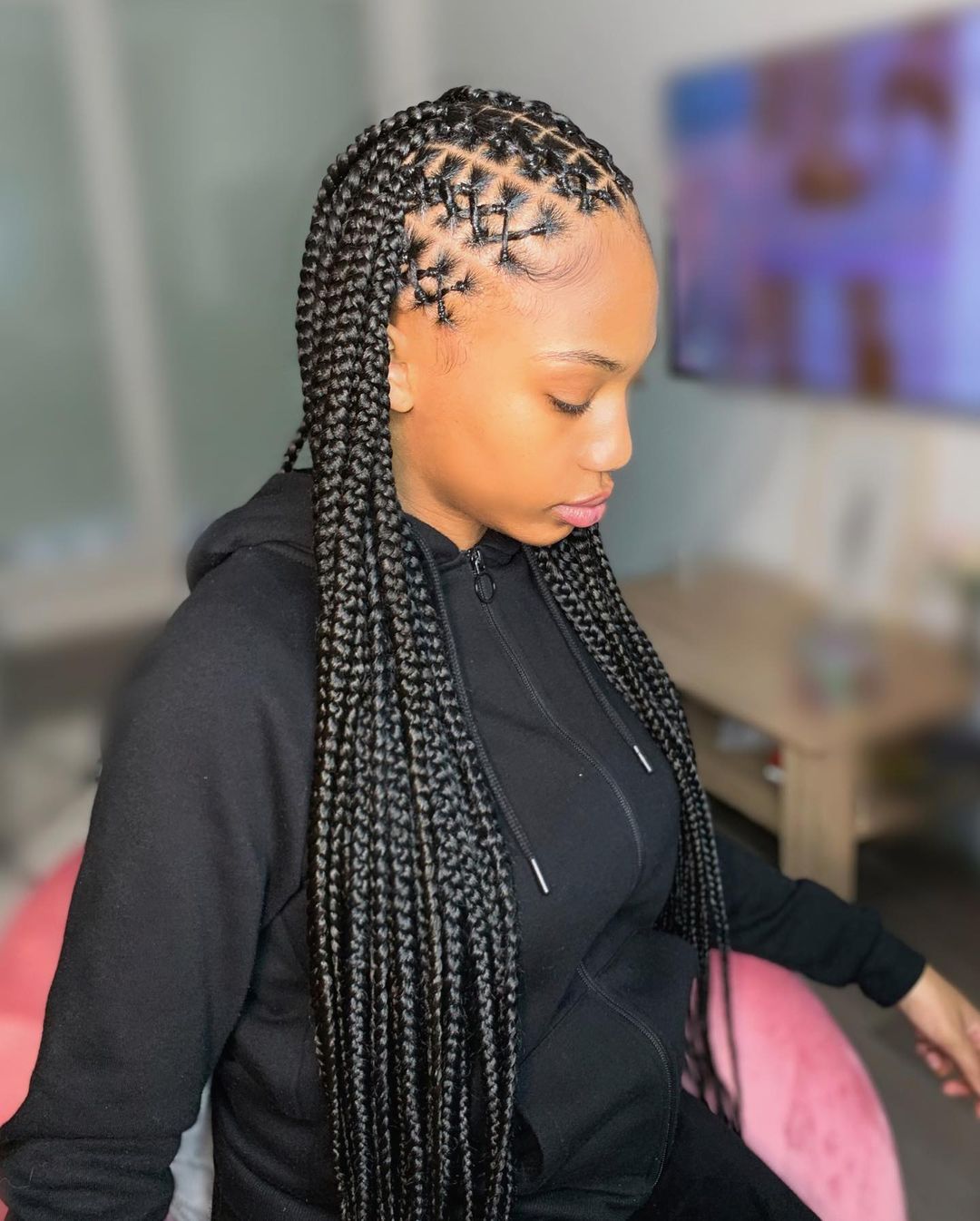
You need a stylist who understands how a geometric parting maps to the scalp. This is precision work, the squares or triangles at the root lead into thick black box braids below. Thick, coily hair gives the geometric lines the sharpest definition. Not for anyone who wants a quick install; this takes time to part correctly.
The result holds well for six to eight weeks if you sleep with a satin scarf. The scalp needs a clean, dry base before each appointment to keep the parting visible.
Thick coily braids with a zig-zag parting pattern
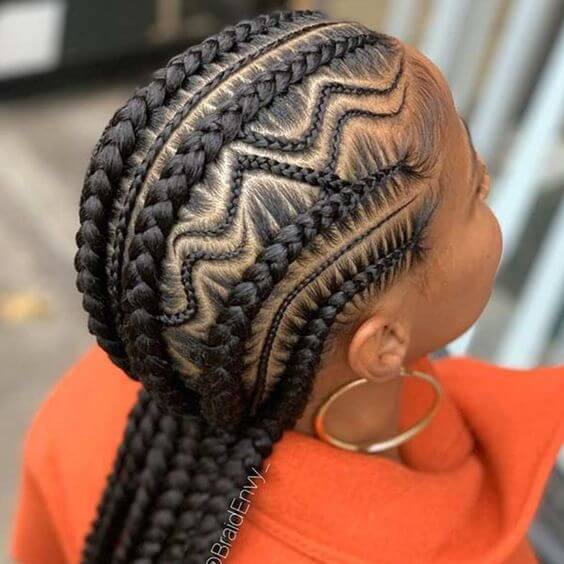
A straight middle part is the default. If you want something that looks intentional, go with a zig-zag instead. Thick, coily hair makes the zig-zag lines stand out. The pattern doesn’t get lost in the texture. Book it as: thick braids with zig-zag parting. Maintain the sharpness of the part by keeping the scalp oil-free between washes. A trim at the eight-week mark keeps the braids from looking frayed at the ends.
Deep black thin box braids neatly parted
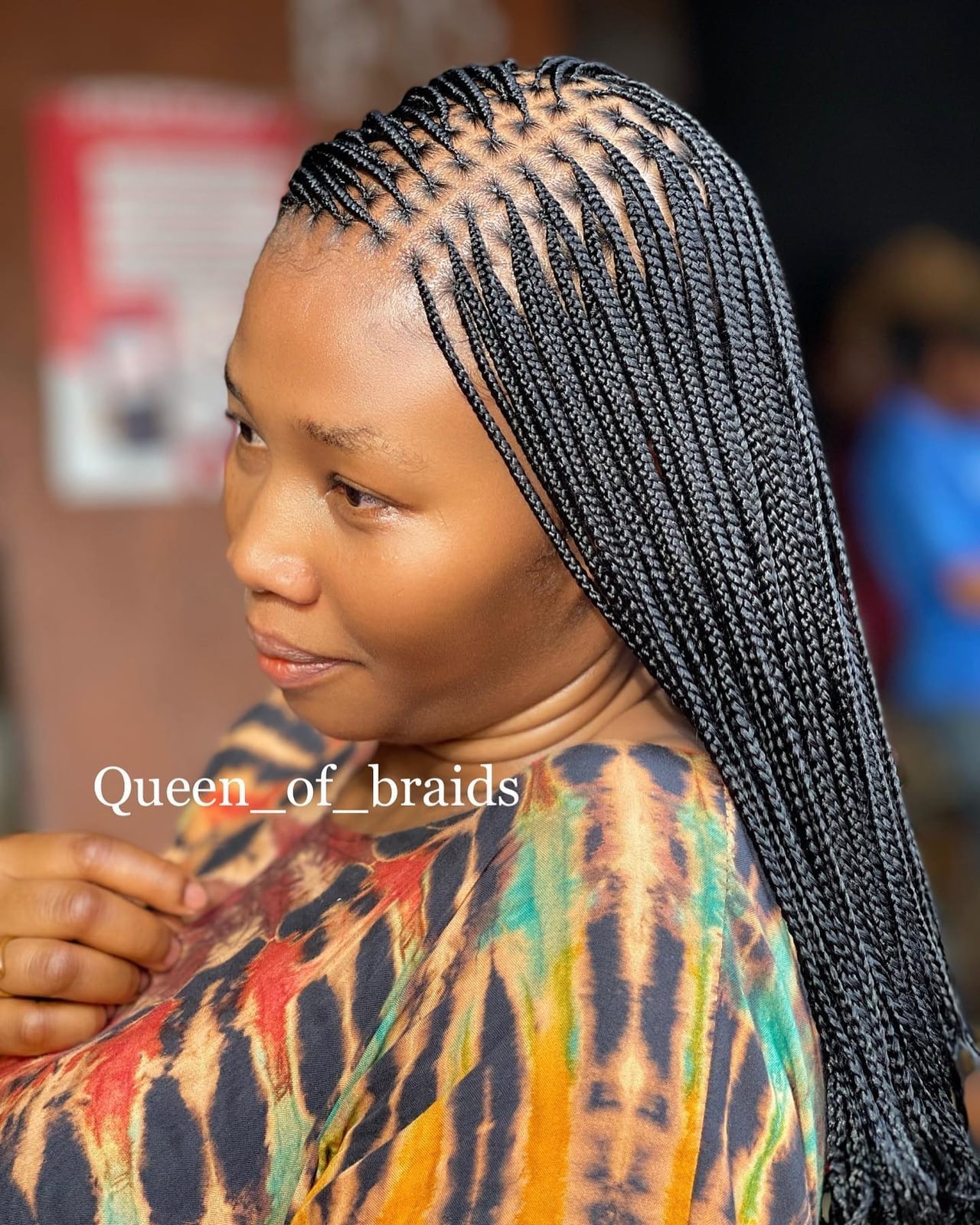
Thin box braids in a deep black shade look clean and deliberate. The neat parting matters more here than with thicker braids, any unevenness shows immediately. Thick, coily hair gives the thin braids enough body to last. Keep them moisturized with a lightweight spray every few days; dry ends make thin braids look stringy. A salon install is the only way to get the parting precise.
Neat cornrows leading into long, thick black braids
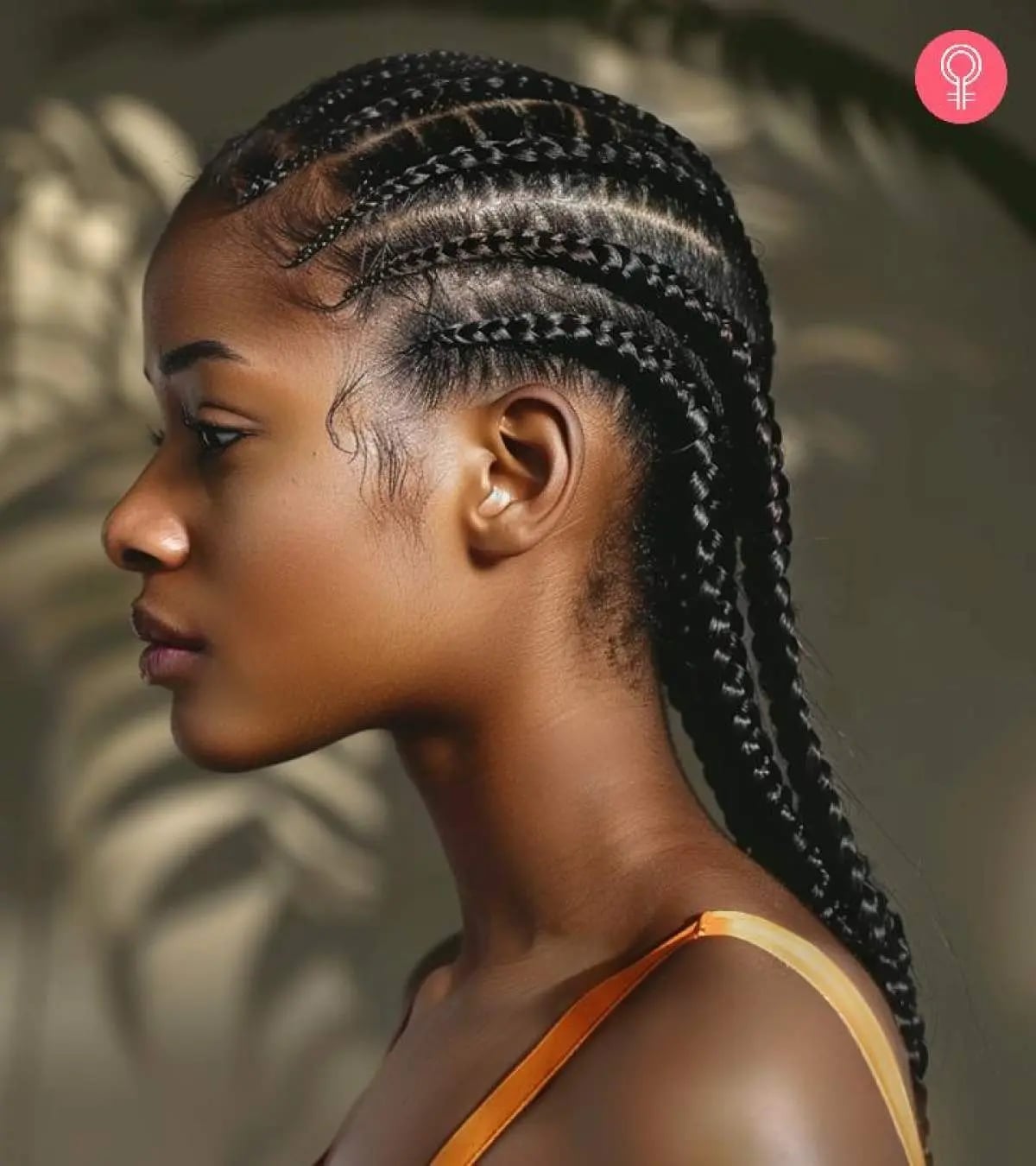
You need a middle parting and a stylist who does not rush. Neat cornrows feed straight into long, thick braids, the transition so clean it looks like one continuous movement. The deep black color keeps the focus on the precision of the rows and the braids. This is a protective style built for thick, coily texture that holds the shape without fighting it.
This look is sharp. Ask your stylist for neat cornrows into long thick braids. The side profile matters here: the cornrows sit flat, the braids fall heavy. A salon touch-up every six to eight weeks keeps the partings tight.
Short, neat box braids framing the face
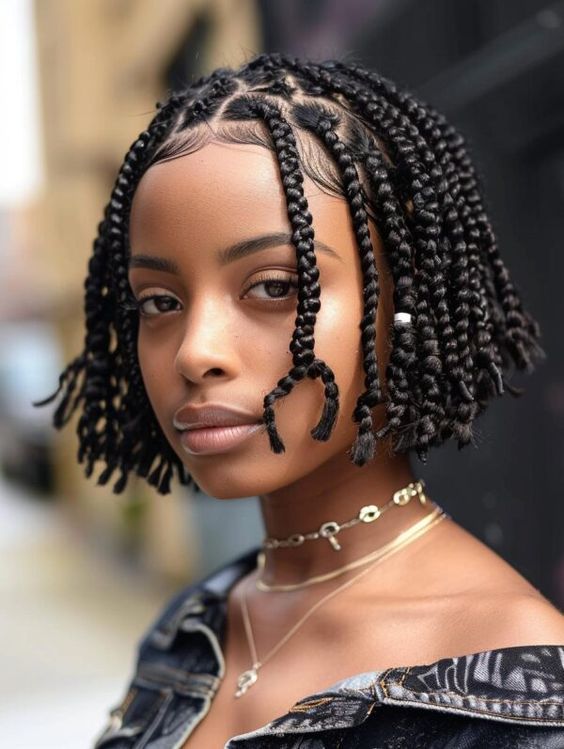
Short box braids cut to a bob length sit cleanly against the jaw. The middle parting gives the face a balanced frame, and the neat, defined lines of each braid keep it neat. Thick, coily texture works best here; the braids hold their shape without straying. This is a cut that stays sharp, no stray ends, no uneven length.
Gold beads on square parted box braids
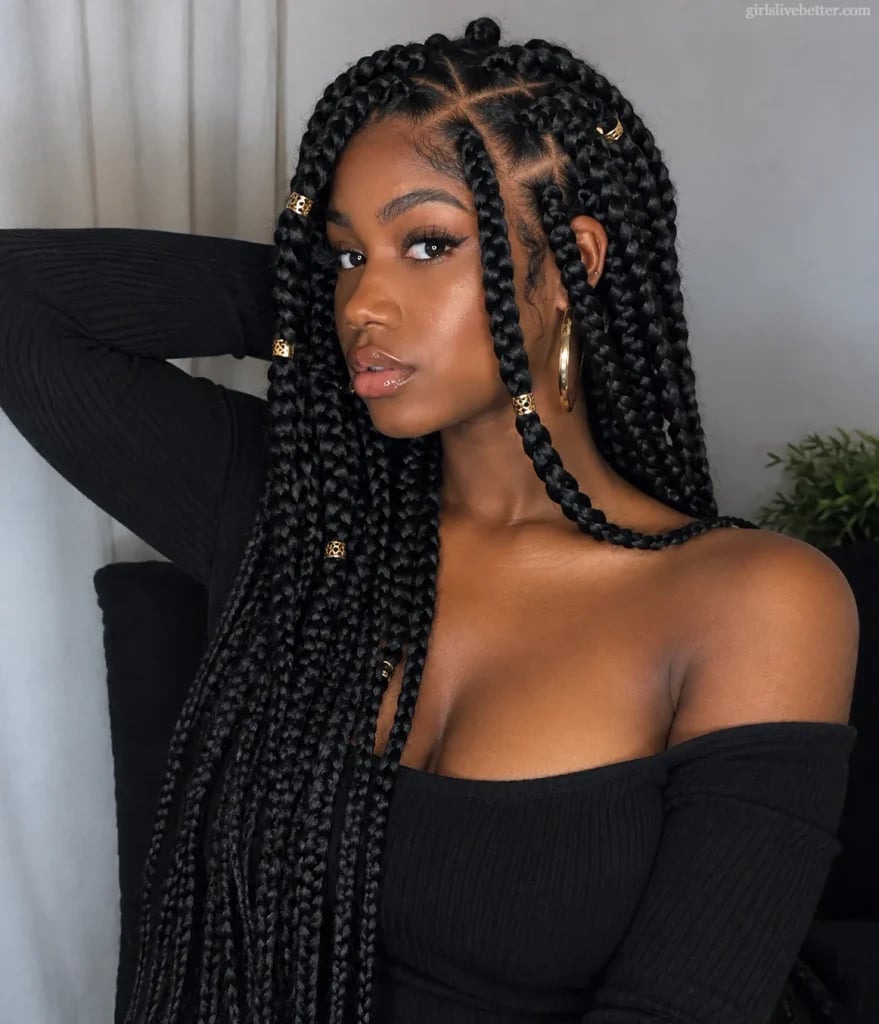
Square parting changes the geometry of a standard box braid set. The clean grid across the scalp gives the style a deliberate structure, and small gold beads on select braids add a metallic accent without overwhelming the look. This suits thick, coily texture that can support beads without pulling at the roots.
Ask your stylist for box braids with square parting and gold beads. The beads sit on a few braids, not all of them, so the style looks neat rather than heavy. Book it as a salon-only request. The square parting needs precision.
Intricate geometric scalp braids into long black box braids
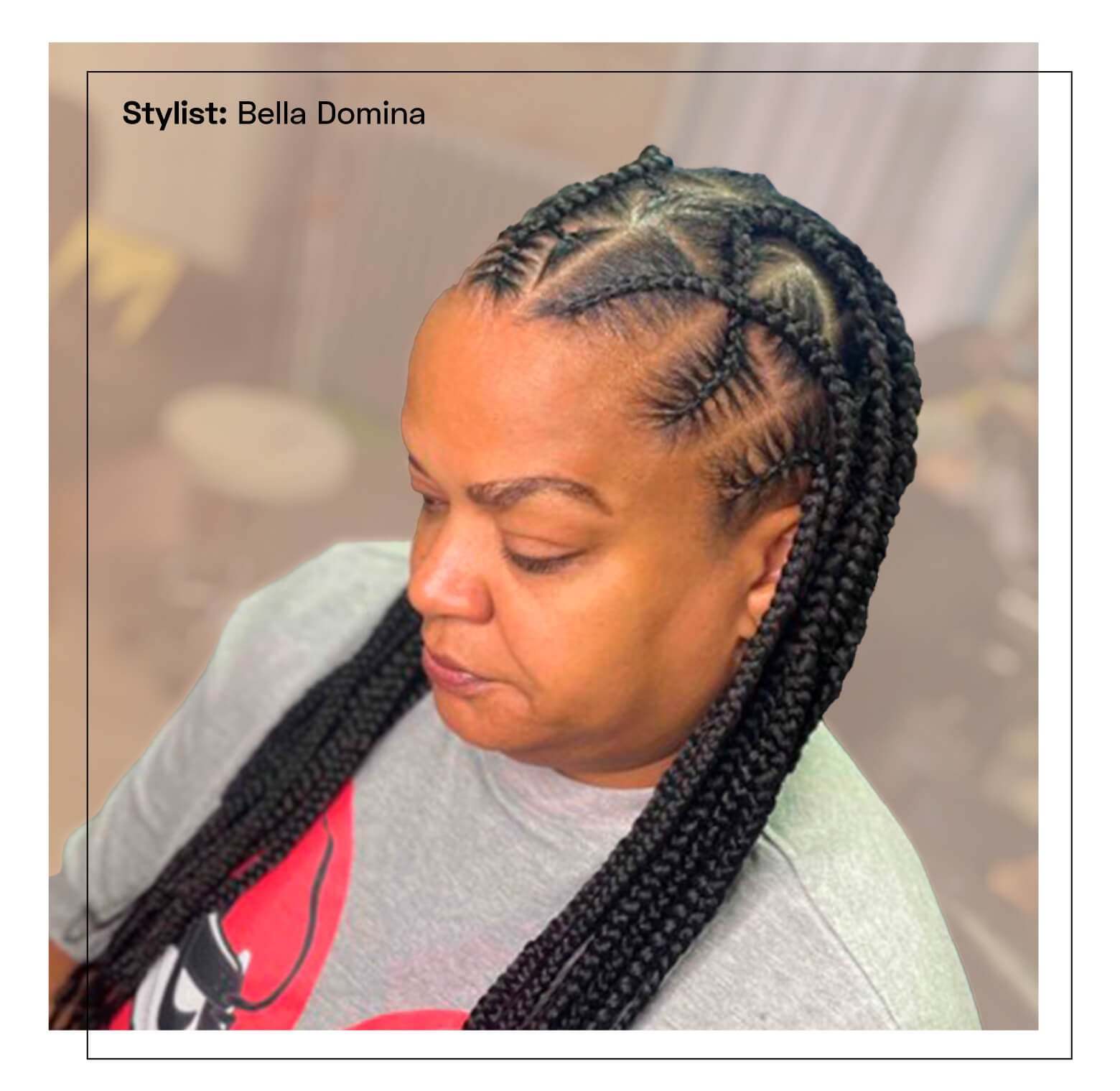
Geometric scalp braids are the headline here. The pattern at the crown is intricate and angular, then the feed transitions into long, thick box braids that fall past the shoulders. The deep black color lets the scalp design read clearly without competition from highlights or gloss. Thick, coily texture holds both the tight cornrow section and the looser braid length.
The words matter because the pattern is specific. You want the scalp section to feel architectural, not random. A side profile view shows the full transition. Salon upkeep every six to eight weeks keeps the geometric lines from blurring.
Final Thoughts
Pick your next set by the detail that matters most to you right now.
- Short on time: choose a simple straight part with medium-thick box braids.
- Love a pattern: go for geometric or zig-zag cornrows that show at the crown.
- Want color: ask for honey blonde or auburn highlights woven through dark braids.
- Scalp needs air: opt for knotless braids or a looser coily texture.
Find the exact braid that fits your life in 2027.